

.jpg "BIM Coordination for a Commercial Lifestyle Center")
Project Overview
Project Name: BIM Coordination — Commercial Lifestyle Center
Location: United States
Project Type: Commercial Lifestyle Center
Built-Up Area: ~200,000 sq.ft
Disciplines: Architectural, Structural, MEP
Delivery Stage: IFC Documentation
eLogicTech provided BIM coordination, clash detection, and construction documentation support for a large-scale commercial lifestyle center in the United States. The engagement focused on stabilizing a fragmented multi-discipline coordination environment and delivering a QA/QC-validated model ahead of IFC issuance.
Client Challenge
Multi-discipline projects operating on parallel design tracks accumulate coordination debt that surfaces at the worst possible time — right before IFC. That is exactly what happened here.
Key project challenges included:
- Architectural, structural, and MEP disciplines working in parallel with limited synchronization
- Clashes being identified late in the coordination cycle, increasing rework exposure
- Rising RFI volume as the project approached the IFC milestone
- Internal BIM team bandwidth constraints limiting coordination cycle management
The client required a dependable BIM partner to absorb coordination workload, stabilize the model environment, and protect the IFC timeline without adding internal headcount.
Scope of Services
eLogicTech delivered end-to-end BIM coordination support from design development through IFC preparation.
Core Services Included:
- Multi-discipline BIM model integration (Architectural, Structural, MEP)
- Iterative clash detection and resolution workflows
- Centralized coordination environment setup and management
- Daily model exchange and stakeholder alignment
- Pre-IFC QA/QC validation — constructability, system routing, inter-discipline dependencies
- Construction documentation support
Technologies Platforms
- Autodesk Revit
- Navisworks (Clash Detection)
- BIM 360
- AutoCAD
BIM Execution & Coordination Approach
A structured coordination workflow was established to progressively resolve clashes rather than allow them to accumulate toward the IFC deadline.
Centralized Model Integration
- Integrated architectural, structural, and MEP models into a single controlled coordination environment
- Standardized model exchange protocols across all discipline teams
- Established daily sync cycles to maintain alignment between stakeholders
Iterative Clash Detection
- Executed clash detection in progressive cycles throughout the design development phase
- Prioritized clash resolution by constructability impact and IFC readiness
- Tracked resolution status across coordination cycles to prevent regression
Pre-IFC QA/QC Validation
- Applied QA/QC validation layer prior to IFC preparation
- Reviewed constructability, system routing logic, and inter-discipline dependencies
- Ensured model issued for construction was reliable and conflict-free
Deliverables
- Fully coordinated multi-discipline BIM model (Architectural, Structural, MEP)
- Clash detection reports with resolution logs
- QA/QC-validated model ready for IFC issuance
- Construction documentation support package
Key Challenges & Solutions
Challenge: Late-stage clash accumulation threatening IFC timeline
Solution: Implemented iterative clash detection cycles throughout design development, surfacing and resolving issues progressively rather than deferring to end-of-phase reviews
Challenge: Fragmented discipline workflows with limited synchronization
Solution: Established a centralized BIM coordination environment with daily model exchanges and standardized integration protocols across all three disciplines
Challenge: Internal team bandwidth constraints limiting coordination capacity
Solution: eLogicTech functioned as a virtual BIM team extension, absorbing peak coordination workload and enabling the client to maintain project velocity without additional hiring
Measurable Outcomes & Client Benefits
- Significant reduction in RFIs ahead of IFC issuance through early clash resolution
- Project timeline maintained despite internal resource constraints
- No additional hiring required — eLogicTech absorbed full coordination workload
- Improved model reliability and design-to-construction handoff quality
- Smoother transition from design development to construction documentation
.jpg "A Dedicated 12-Person MEP BIM Modeling Team for a Dubai Consultancy, Delivered Across a Planned Two-Phase Transition")
A Dedicated 12-Person MEP BIM Modeling Team for a Dubai Consultancy, Delivered Across a Planned Two-Phase Transition
.jpg "A Dedicated 12-Person MEP BIM Modeling Team for a Dubai Consultancy, Delivered Across a Planned Two-Phase Transition")
A Dedicated 12-Person MEP BIM Modeling Team for a Dubai Consultancy, Delivered Across a Planned Two-Phase Transition
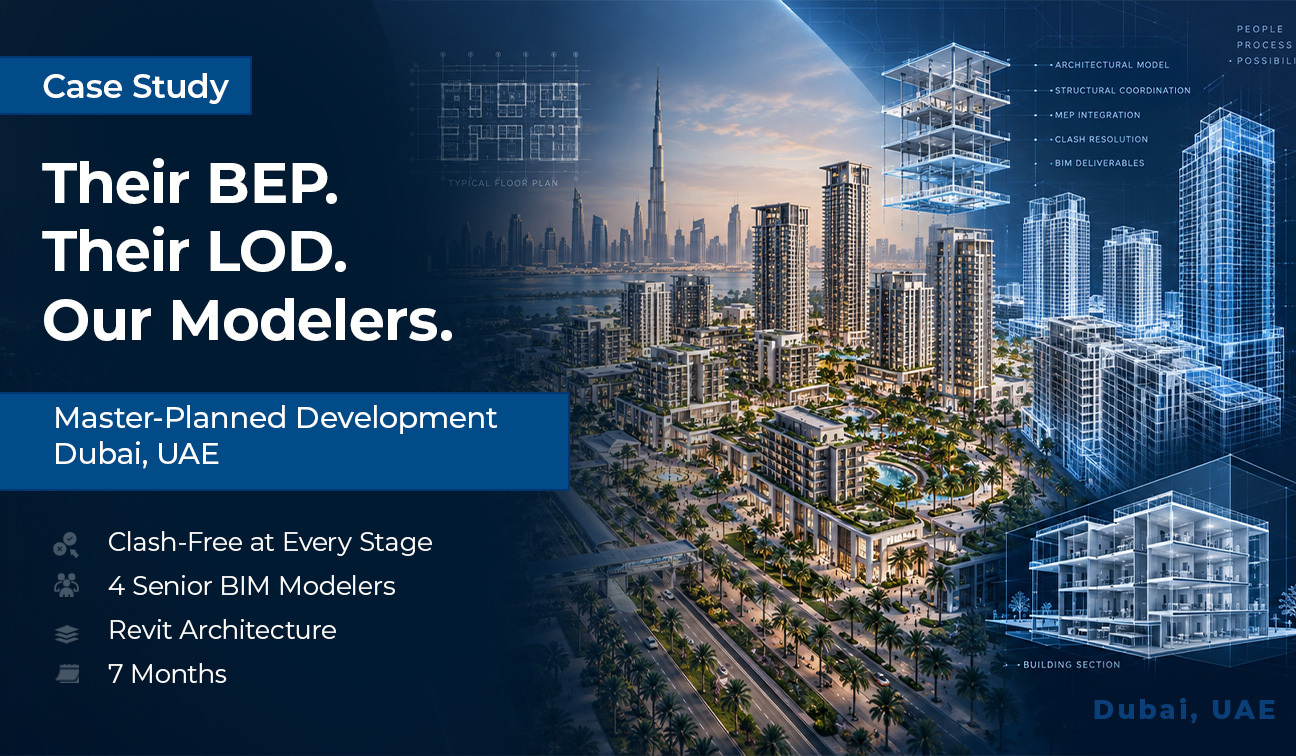
Embedded Senior BIM Modeling Team for a Large-Scale Master-Planned Development in Dubai
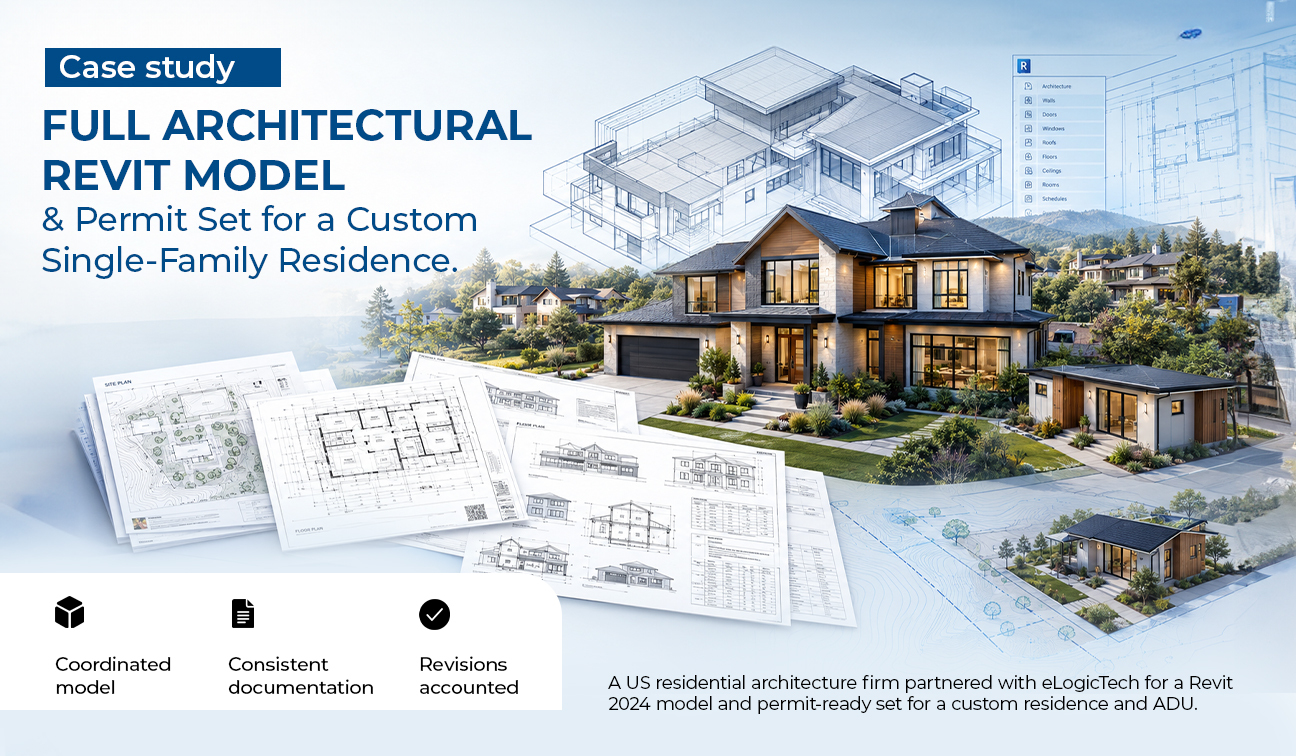
Full Architectural Revit Model & Permit Set for a Custom Single-Family Residence
.png "Revit Modeling & Rendered Visuals for Three Interior Spaces in a Recreation Venue Build-Out")
Revit Modeling & Rendered Visuals for Three Interior Spaces in a Recreation Venue Build-Out
Need Help?
Don't hesitate to contact us for more information about company or service